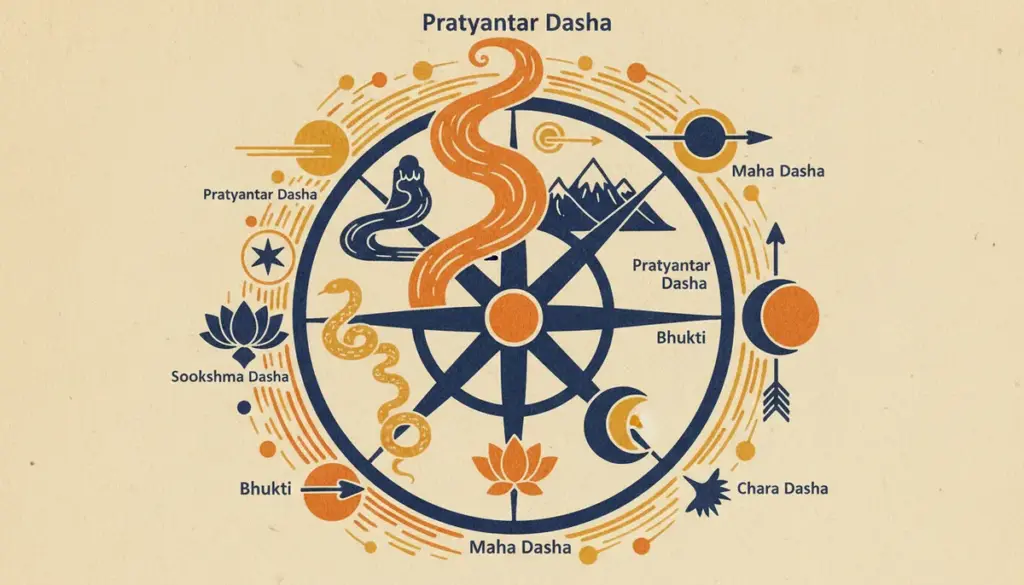
When exploring Vedic astrology, understanding pratyantar dasha compared with other dasha systems helps clarify how ancient scholars mapped out human life into distinct periods. A Pratyantar Dasha is the third tier of time within the standard Vimshottari framework, serving as a sub-sub-period beneath the major Mahadasha and the intermediate Antardasha. While a Mahadasha outlines multi-year life chapters and an Antardasha highlights months, a Pratyantar Dasha narrows focus down to short spans lasting only days or weeks. You can explore your own personal schedule using the vimshottari-dasha tool.
What Pratyantar Dasha means for time division in the chart
Vedic astrology uses planetary periods, known as Dashas, to show how themes unfold across time. The main period is the Mahadasha, which can last for many years depending on the ruling planet. Inside that major span, smaller divisions called Antardashas divide the time into months. The third tier is the Pratyantar Dasha, which splits each Antardasha into nine smaller planetary segments.
This third tier follows the exact same sequential order as the primary Dasha cycle. For instance, if a specific sub-period is active, its internal sub-sub-periods will cycle through all nine celestial bodies in the traditional sequence. This setup creates a micro-climate of energy within a larger planetary chapter. Readers often review their broader background by checking the vimshottari dasha explained guide.
How tradition links Pratyantar Dasha with alternative cycles
The Vimshottari framework is not the only method used by practitioners to study time. Alternative models exist, such as Yogini Dasha, which relies on a compressed 36-year cycle distributed among eight divine feminine energies rather than a 120-year cycle. Another model is Ashtottari Dasha, an alternative conditional framework spanning 108 years that excludes Ketu and uses a different structural sequence.
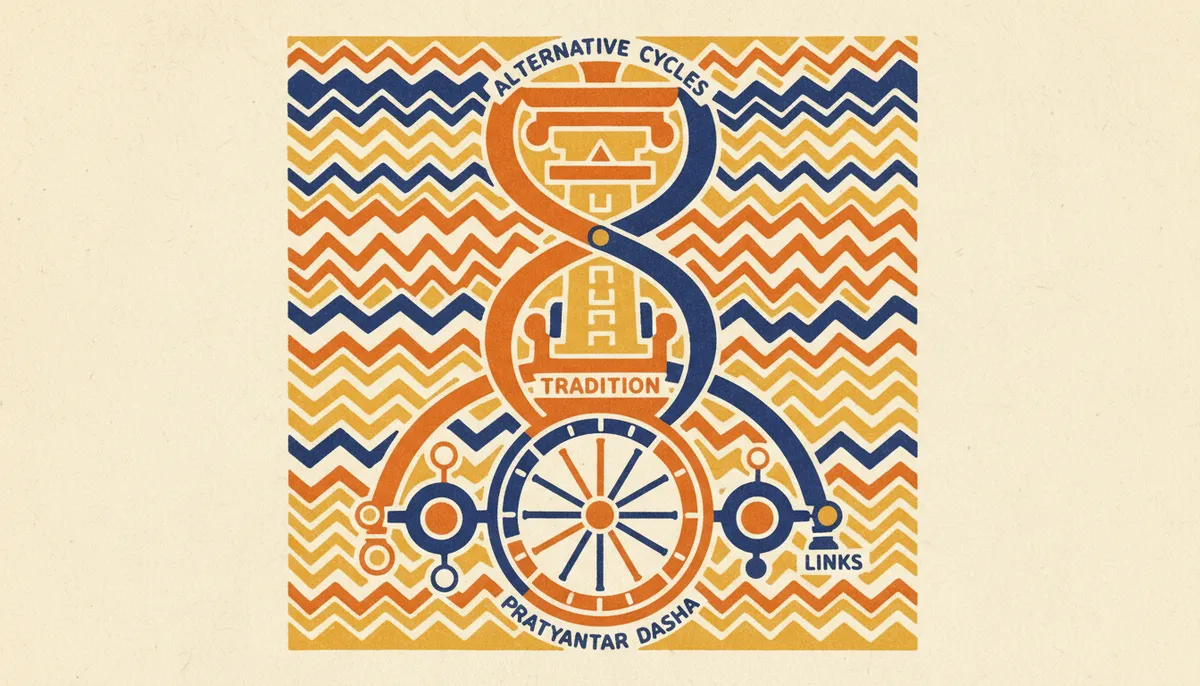
When looking at pratyantar dasha compared with other dasha systems, the main difference lies in the depth of the tier. While Vimshottari uses a three-tier tree of Mahadasha, Antardasha, and Pratyantar Dasha to reach down to daily influences, sign-based systems such as Chara Dasha utilize entire zodiac signs, known as Rashis, instead of planets to govern periods. You can test sign-based periods using the chara-dasha tool.
Pratyantar Dasha compared with other dasha systems: what readers notice
Observers often wonder why different time frameworks seem to overlap or offer distinct angles. A person might be in a stable multi-year planet chapter under Vimshottari while experiencing a shift in a sign-based system. This dual layer of interpretation is common in traditional study. Astrologers frequently utilize alternative frameworks alongside Vimshottari sub-periods to cross-verify major life events.
The short span of a third-tier sub-period means its effects tend to feel subtle or fleeting. Rather than shifting an entire life direction, these brief windows highlight minor adjustments in daily focus, mood, or tasks. Traditional texts suggest that these micro-periods act like the weather on a specific afternoon within a larger seasonal change.
Where schools differ on Pratyantar Dasha and planetary models
Schools of Jyotish vary in how they weigh different timing systems. Some lineages rely almost exclusively on the planetary tree of Vimshottari down to the smallest sub-sub-period. Other traditions prefer to blend planetary models with sign-based cycles or conditional systems to gain a balanced view of short-term patterns.
Disagreements also appear in how scholars calculate the exact start and end moments of these rapid sub-spans. While mathematical formulas for proportional subdivision are widely agreed upon, minor variations in ayanamsha or chart settings can shift timings by a few hours. Students are encouraged to focus on the general flow of themes rather than exact hour counts.
A calm way to reflect on daily timing using your birth details
Approaching your chart requires patience and an open mind. Birth details are not stored on our servers when you run calculations on this site. You can generate your full chart layout safely by visiting the kundli page.
Astrology is for reflection and guidance, and it is not a substitute for professional advice. Treat these timelines as a mirror for your inner thoughts rather than a rigid schedule of events. Observing how your focus shifts during different sub-periods can be a useful mindfulness exercise.
Practical observations on sub-periods in traditional study
Working with third-tier sub-periods teaches patience because the phase changes quickly. A tense or demanding few days will pass rapidly as the sequence moves to the next planetary ruler. This constant motion reminds the observer that life situations are always in flux.
Many learners keep a simple journal to note how their daily energy aligns with active planetary rulers. Over months and years, this personal record provides interesting patterns for self-study. It turns abstract math into a grounded practice of self-awareness.