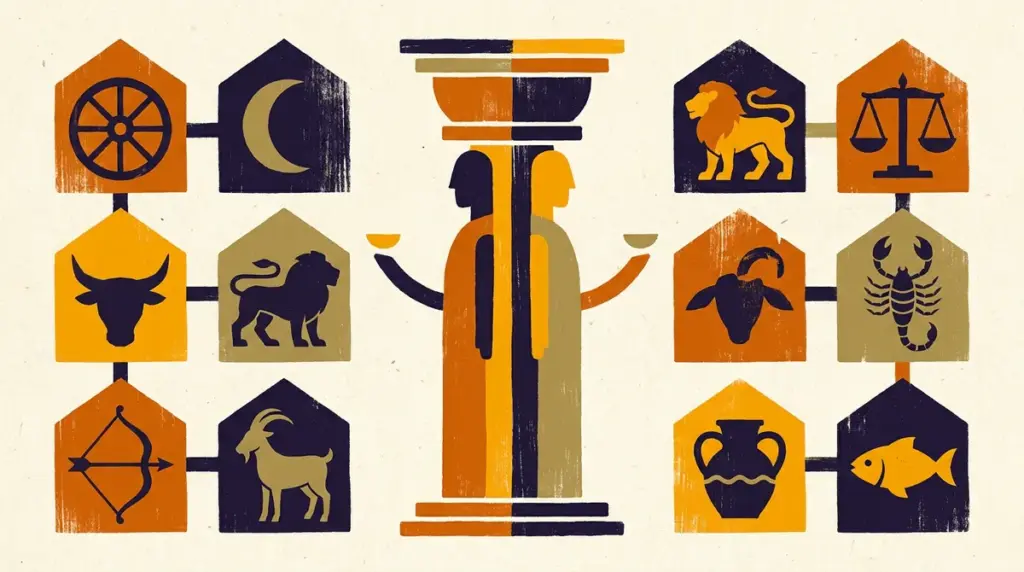
Understanding the gemini ascendant house lords overview helps you see how your chart is structured. In Vedic astrology, the rising sign or Lagna is the sign on the eastern horizon at birth. It sets the stage for everything else. You can find your own rising sign using our rising-sign-calculator. The house lords are the planets that rule each of the twelve signs. Each planet acts as a steward for the house where its sign sits. For a Gemini rising, Mercury is the Lagna lord. It acts as the primary guide for the whole chart.

Meaning of the Gemini Ascendant house lords overview
The house lords define the themes for each area of life. A house lord is known as a Bhavesha. This is the planet ruling the sign on the cusp of a house. For Gemini, Cancer is in the second house. This means the Moon rules the second house. The Moon brings themes of family and speech to this area. Because there are only seven classical planets, most planets rule two signs. This creates a complex network of connections across your chart. You can read more about the general framework in our guide on Lagna (Ascendant) Explained.
How tradition views the Gemini Ascendant house lords overview
Tradition places great weight on the dignity of these lords. Dignity refers to the strength or weakness of a planet in a sign. A strong lord supports the house it rules. A weak lord might struggle to manifest those themes. For Gemini, Venus is often seen as very auspicious. It rules the fifth house, which is a trine. Trines are houses associated with intellect, merit, and creativity. Jupiter is another key player. It rules the seventh house and the tenth house. This links your career and your partnerships closely together.
What students notice about Gemini Ascendant house lords overview
Many students notice how the Gemini ascendant house lords overview connects different life areas. Saturn, for example, rules both the eighth and ninth houses. The eighth house deals with crises and transformation. The ninth house is for spiritual fortune and higher learning. This pairing often links spiritual growth with sudden or deep changes. Mars is the lord of the sixth and eleventh houses. The sixth house governs service and conflict. The eleventh house is for gains and social circles. This suggests that your gains often come through your daily service or work.

Where traditions differ on Gemini Ascendant house lords overview
Schools of thought often differ on how to weigh these lords. One common debate involves the Kendradhipatya Dosha. This is a concept where a natural benefic planet becomes less auspicious. This occurs when it rules two angular houses. Jupiter rules the fourth and seventh houses for some signs, but for Gemini, it rules the seventh and tenth. Some scholars argue this reduces the positive impact of the planet. Others suggest the planet remains a strong supporter of the person. These views depend on the specific branch of Vedic astrology you study.
A calm way to reflect on the Gemini Ascendant house lords overview
Astrology is for reflection and guidance, and it is not a substitute for professional advice. When looking at your chart, stay calm and observe the patterns. Do not look for absolute outcomes. Instead, see the houses as areas of potential growth. A house lord in a good position might show ease in that area. A lord in a difficult position might show where you must put in more effort. Use your kundli to see where these planets sit. Focus on how the planets interact with one another.
Practical application of planetary lordship
Let us look at a short example. Imagine your Moon is in the tenth house. The Moon rules your second house of wealth. This placement suggests your family or your speech might influence your career path. You might find success in fields related to food, care, or public speaking. The house lords carry the agenda of their houses into their new home. This is how you connect the dots in your own life. Always check the dignity of the planet to see how it performs its duties.