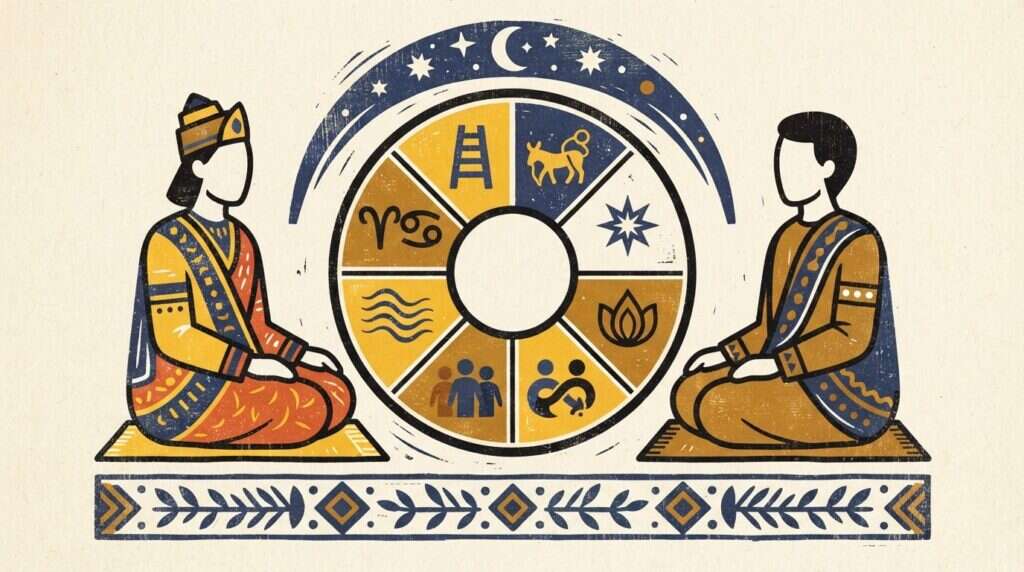
In Vedic astrology, ashtakoot matching eight kootas provides a structured framework for assessing relationship compatibility before marriage. The system evaluates the birth stars of two people across eight distinct categories. The word Ashta means eight, and Koota means category or dimension. Together, these eight dimensions yield a total score out of 36 points, commonly called gunas. Astrologers use this score as a helpful starting point to see how two personalities align.
Rather than deciding a couple’s future outright, this method offers a clear lens on daily interaction, emotional balance, and family life. If you want to check your compatibility score, you can test it directly on our kundli matching tool. Your birth details are not stored on our servers.
Understanding Ashtakoot Matching Eight Kootas
The practice of ashtakoot matching eight kootas relies mainly on the position of the Moon at birth. In Vedic astrology (Jyotish), the Moon represents the mind, emotional instincts, and everyday reactions. Because marriage involves daily companionship, the lunar placement gives strong clues about domestic peace.
The system calculates each factor using two primary markers. The first is the Janma Rashi (Moon sign), which is the zodiac sign where the Moon rested at birth. The second is the Janma Nakshatra (birth star), which is one of the 27 lunar mansions. You can discover your exact birth star with our nakshatra finder. By comparing the Moon signs and birth stars of the two partners, the formula assigns points to each category.
Each koota carries an increasing point value from 1 to 8. The total sum of all eight kootas equals 36 points. To explore the mathematical breakdown further, see our guide on kundli matching and the 36 gunas.
The Eight Kootas and Their Point Values
The eight kootas measure different layers of human partnership. They range from work ethics and social drives to psychological rapport and physical health. Below is the traditional list of the eight categories in order of their assigned points.
Varna: Spiritual Compatibility and Temperament
Varna carries a maximum value of 1 point. It reflects spiritual alignment, personal ego, and mental inclination. In traditional thought, the twelve signs fall into four classes: Brahmin (intellectual and philosophical), Kshatriya (protective and ambitious), Vaishya (practical and trade-focused), and Shudra (service-oriented and grounded). When partners share balanced varna, they tend to support each other’s inner values without competing for intellectual dominance.
Vashya: Mutual Influence and Attraction
Vashya carries a maximum value of 2 points. This factor explores natural attraction and mutual influence. It categorizes signs into five classes based on symbolic forms: humans (Dwipada), quadrupeds (Chatushpada), creatures of water (Jalachara), forest animals (Vanachara), and insects (Keeta). Vashya helps assess whether two people find it easy to cooperate or whether power struggles might occur in basic decision-making.
Tara: Health and Well-Being
Tara carries a maximum value of 3 points. The word Tara refers to the birth star cycle. This calculation counts the distance between the two birth stars and divides by nine. It reflects mutual longevity, health, and general fortune. A favorable Tara score indicates that the partnership fosters mutual comfort and emotional renewal over time.
Yoni: Intimacy and Biological Nature
Yoni carries a maximum value of 4 points. It represents physical harmony, intimate chemistry, and natural instincts. Each nakshatra links to a symbolic animal archetype, such as a horse, elephant, tiger, or deer. Some animal archetypes are naturally friendly, while others hold symbolic enmities. A healthy Yoni score suggests ease with physical affection, tolerance, and basic lifestyle rhythms.
Graha Maitri: Psychological Harmony and Friendship
Graha Maitri carries a maximum value of 5 points. It evaluates the planetary friendship between the rulers of the two Moon signs. For instance, if one person has a Moon in Leo (ruled by the Sun) and the other has a Moon in Aries (ruled by Mars), their rulers are natural friends. Graha Maitri reveals how easily the couple can talk, build deep friendship, and understand each other’s outlook on life.
Gana: Temperament and Behavioral Archetypes
Gana carries a maximum value of 6 points. It groups the 27 nakshatras into three broad temperaments: Deva (divine or gentle), Manushya (human or practical), and Rakshasa (strong-willed or rebellious). Matching Gana ensures that social behavior and basic worldviews mesh well. While Deva types focus on peace and diplomacy, Rakshasa types prefer boldness and sharp initiative. Similar temperaments make household routines smoother.
Bhakoot: Emotional Bonding and Family Growth
Bhakoot carries a maximum value of 7 points. It examines the relative house distance between the two Moon signs. Astrologers view certain sign combinations as smooth, while others, such as 6/8 (Shadashtak) or 9/5 (Navapancham), can bring emotional misunderstandings. Bhakoot reflects financial prosperity, family happiness, and the emotional resilience of the home. Because it holds 7 points, it carries strong weight in the total calculation.
Nadi: Vital Energy and Heredity
Nadi carries the highest value of 8 points. It assesses physiological balance, nerve energy, and genetic compatibility for childbearing. The three Nadis are Aadi (beginning or vata-like), Madhya (middle or pitta-like), and Antya (end or kapha-like). The tradition advises that partners belong to different Nadis to ensure vital health and hereditary balance. Sharing the same Nadi leads to Nadi Dosha. You can read more about remedies and rules in our article on Nadi and Bhakoot dosha.
How Guna Milan Scores Are Evaluated
Once all points are summed, astrologers place the total out of 36 into general guidance categories. A score of 18 points is traditionally accepted as the bare minimum for an auspicious match. Matches between 18 and 24 points are considered average or acceptable. Scores from 25 to 32 points are seen as very favorable, and scores above 32 are rare and celebrated.
However, numbers tell only half the story. A couple might score 26 points but have zero points in Nadi or Bhakoot. Because Nadi (8 points) and Bhakoot (7 points) together represent 15 points, losing either can raise concerns among traditional readers. In many classic texts, specific cancellation rules (dosha parihara) exist. For example, if the rulers of the Moon signs are the same or mutual friends, certain Bhakoot or Nadi faults are viewed as neutralized.
North Indian Ashtakoot vs South Indian Dashakoota
While the Ashtakoot system is standard across North Indian traditions, it is not the only method in Vedic astrology. South Indian astrological traditions often employ a ten-factor method known as Dashakoota. This system includes additional criteria such as Mahendra (welfare and family longevity) and Stree Deergha (auspicious distance from the bride’s star).
These regional variations demonstrate that astrology has never been a rigid, one-size-fits-all formula. Different historical schools placed different emphases on various aspects of compatibility. Recognizing these regional systems helps keep compatibility assessments balanced, open-minded, and grounded.
Looking Beyond Ashtakoot Matching
Even an exceptional score in the eight kootas does not tell everything about a relationship. Traditional astrologers never rely on the ashtakoot score alone. The Moon sign analysis must be supported by the complete birth chart (Lagna Kundli).
For instance, one must evaluate the 7th house of marriage, its planetary ruler, and the placement of Venus or Jupiter. It is also standard practice to inspect Mars to evaluate any potential Mars affliction. You can calculate this placement using our Manglik dosha tool. Furthermore, studying individual longevity, career stability, and running planetary periods (dashas) gives a much clearer picture of life together.
Astrology is for reflection and guidance, not a substitute for professional advice. Compatibility scores provide a symbolic map of strengths and areas for mutual growth. Real-world understanding, patience, open communication, and shared values remain the true foundation of any lasting union.