
When exploring Vedic compatibility, many ask about ashtakoota matching how it is scored. This system uses eight specific factors to calculate a total score of 36 points. Each category holds a different weight based on its importance in the tradition. By understanding these points, you can better reflect on your partnership.
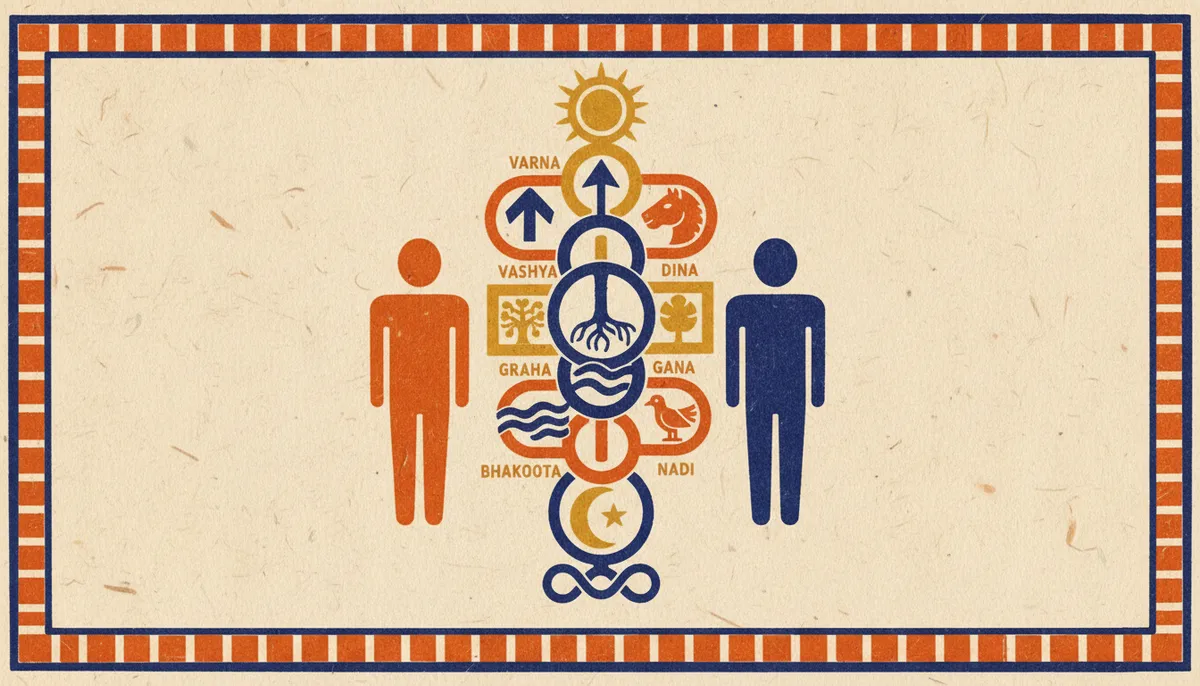
The foundation of ashtakoota matching how it is scored
The system relies on the position of the Moon in the birth chart. The Moon is called the Chandra, which represents the mind and emotions. The calculations determine how two minds might interact over time. Each of the eight categories, known as Kootas, offers a specific number of points. These points total 36 when combined. This total is often called the Guna score. Using the kundli-matching tool can help you see these values clearly.
Tradition and the logic of the eight categories
Each Koota covers a different aspect of life. Varna relates to spiritual development and ego. Vashya concerns mutual attraction and power dynamics. Tara focuses on the health and longevity of the bond. Yoni deals with physical and mental compatibility. Graha Maitri examines the friendship between the Moon signs. Gana looks at the nature of the temperament. Bhakoot explores the influence of the Moon’s position. Nadi is the final factor and relates to genetic health.

Points are distributed as follows: Varna (1), Vashya (2), Tara (3), Yoni (4), Graha Maitri (5), Gana (6), Bhakoot (7), and Nadi (8). Nadi is the heaviest category. You can read more about the importance of these factors in Ashtakoot Matching Eight Kootas Explained. The tradition emphasizes that no single factor dictates the entire outcome.
What people notice when reviewing their compatibility results
Many users look for a high score, often hoping for a perfect 36. However, tradition does not demand a perfect score for a harmonious life. A score of 18 is often seen as the baseline for compatibility. Scores above 25 are usually considered very strong. Some people might find that certain categories have zero points. This is not necessarily a sign of trouble. It simply means that specific area may require more conscious effort in the relationship.
Regional variations in how points are calculated
Not all schools of thought agree on every rule. Some traditions apply exceptions based on planetary friendships. Others might prioritize different factors depending on the region. These variations are a natural part of the long history of Vedic astrology. It is helpful to remember that these calculations are meant to offer a framework. They are not absolute rules that define a person’s path. Always look at the entire kundli, or birth chart, rather than just one number.
A worked example of the point system in practice
Imagine two individuals whose charts have been compared. In this example, they earn 1 point for Varna and 2 for Vashya. They receive 3 points for Tara and 4 for Yoni. For Graha Maitri, they gain 5 points. They earn 6 points for Gana. For Bhakoot, they get 7 points. Finally, they receive 8 points for Nadi. Adding these up, the couple reaches a score of 36. This is a rare and high result in the system.
A calm way to reflect on your matching results
Astrology is for reflection and guidance, and it is not a substitute for professional advice. Use these tools to understand your own nature. Look at how you communicate and relate to others. The numbers are just a starting point for conversation. They do not store birth details on our servers. Approach your results with patience and an open mind. Compatibility is a journey that involves daily choices and mutual respect.