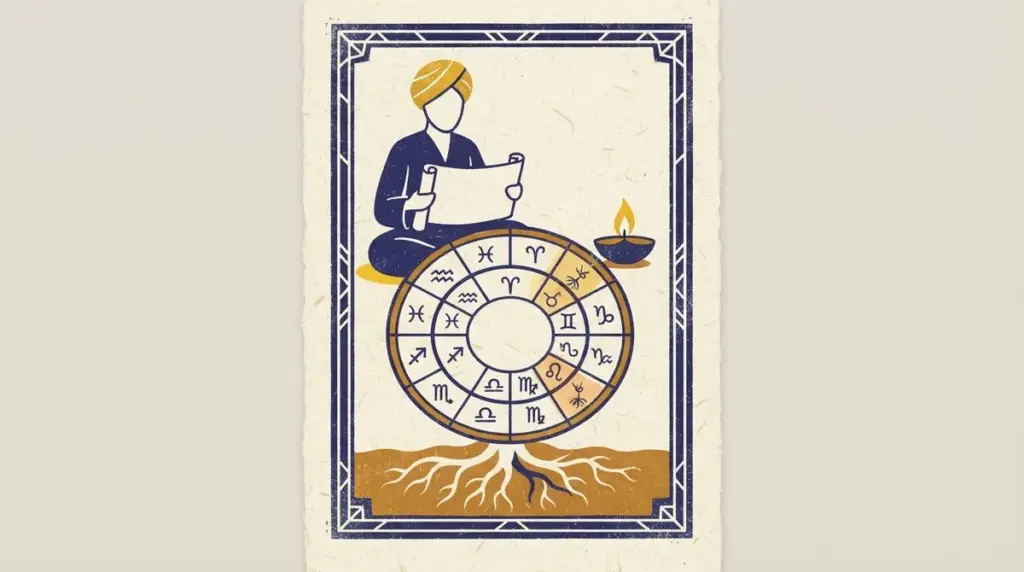
When you want to understand gand mool dosha how to check, you need to look at the exact position of the Moon in your birth chart. Vedic astrology, known as Jyotish, treats this condition as a specific energetic knot found at the root of a horoscope. The term comes from Sanskrit. Gand means knot or joint. Mool means root. Traditional texts describe this placement with great care, while modern astrologers look at the whole chart for balance. You can use tools like the nakshatra-finder to pinpoint your birth star quickly. Finding this condition does not mean you face a fixed doom. Instead, it invites calm reflection on your life path and natural tendencies.
What Gand Mool Dosha means for how to check
To begin the evaluation, you must first understand the core mechanics of the condition. Gand Mool Dosha occurs when the Moon sits inside one of six specific Nakshatras, or lunar mansions, at the precise moment of birth. These six star groups are Ashwini, Ashlesha, Magha, Jyeshtha, Mula, and Revati. Each of these zones carries a distinct energetic signature related to transitions and growth. When you study the avakhada chakra of your chart, you look for your Janma Nakshatra, which means the birth star. If your Moon rests in any of these six sectors, the chart qualifies for further review. You can also explore your broader chart structure using the kundli page to see how other planets interact with these sensitive areas.
The tradition views these six regions as junction points between different zodiac signs. They mark the borders where watery signs meet fiery signs. These intersections are known as Gandanta points, representing a deep karmic shift. People often wonder if every single degree of these star groups triggers the condition equally. Classical texts suggest that the exact quarter, or Pada, plays a major role in the intensity of the placement. By identifying the correct pada, you gain a clearer picture of how the energy manifests in your daily experience.
How tradition links Gand Mool Dosha with how to check
Ancient texts associate these specific lunar placements with various themes in early childhood, health, and family dynamics. The underlying idea is that a soul entering the physical world through a junction point experiences a powerful surge of energy. This surge can create hurdles or require extra care during formative years. The six stars involved are ruled by two distinct planets. Ketu rules Ashwini, Magha, and Mula. Mercury rules Ashlesha, Jyeshtha, and Revati. You can read more about how these planetary rulers operate by studying Your Moon Nakshatra and What It Says for deeper insights into lunar constellations.
Because Ketu and Mercury govern these zones, the mental and spiritual dimensions of the person are often highlighted. Ketu brings an inclination toward inner reflection, spiritual seeking, and detachment. Mercury brings sharp intellect, quick communication, and a busy mind. When the Moon resides in these nakshatras, the mind may experience periods of high activity or sudden shifts in perspective. Traditional observers note these tendencies to understand why certain individuals feel more restless or deeply introspective than others.
Gand Mool Dosha and how to check: what readers notice
Many individuals discover this condition when they compile their birth charts for the first time. They often feel a wave of anxiety upon seeing the word dosha, which simply means a fault or blemish in Sanskrit. However, understanding how to check the chart properly removes much of the unnecessary fear. You might notice that you possess a very active imagination or a strong desire to explore spiritual topics. These traits stem directly from the nature of the nakshatras involved in the configuration.
Readers also report that recognizing this placement helps them make peace with their personal challenges. Instead of viewing a difficult phase as a curse, they learn to see it as a natural part of their astrological makeup. The tradition offers various remedies, such as the Gand Mool Shanti Puja, which is ideally performed on the 27th day after birth when the Moon returns to the same nakshatra. If that window has passed, families often perform a similar ritual later in life when the Moon transits the birth star again. These practices aim to soothe the mind and restore inner harmony.
Where schools differ on Gand Mool Dosha and how to check
Different schools of Vedic astrology interpret this condition with varying degrees of strictness. Some traditional practitioners argue that the presence of the dosha requires immediate remedial measures to balance the planetary energies. They place heavy emphasis on the exact pada of the nakshatra, noting that the junction padas at the very beginning or end of the star groups carry the strongest weight. For instance, the final quarter of Ashlesha, Jyeshtha, or Revati, and the first quarter of Ashwini, Magha, or Mula, are considered the most sensitive areas.
On the other hand, many modern astrologers take a more flexible approach. They argue that a single placement cannot dictate the entire outcome of a life. They look for balancing factors in the horoscope, such as benefic planets aspecting the Moon or a strong overall ascendant lord. If Jupiter or Venus casts a supportive glance toward the Moon, the challenging qualities of the dosha are often tempered. This balanced perspective reminds us that astrology is meant to guide us rather than box us into rigid categories.
A calm way to reflect on how to check with Gand Mool Dosha
Approaching your birth chart requires patience, an open mind, and a calm emotional state. When you sit down to check your horoscope, remember that every configuration has both light and shadow sides. Gand Mool Dosha highlights a sensitive emotional core and a potential for deep spiritual awakening. By understanding the exact nakshatra and pada of your Moon, you gain valuable self-knowledge. You begin to understand why you react to certain situations with intense emotion or why you seek solitude during stressful times.
Astrology is for reflection and guidance, and it is not a substitute for professional advice. Use these insights as a mirror to explore your inner landscape rather than a prophecy of fixed events. Whether you choose to perform traditional pujas or simply focus on mindful self-care, the goal is always personal growth and peace of mind. Your chart is a map of tendencies, but your conscious choices shape your daily reality.
Step-by-step instructions for gand mool dosha how to check
To check your chart for this condition, follow a clear, systematic process. First, gather your exact birth date, birth time, and birth place. Accurate time is crucial because the Moon moves through nakshatras relatively quickly, changing star groups roughly every twenty-four hours. Next, generate your birth chart using a reliable astrological calculator. Locate the Moon symbol in your chart layout and note the zodiac sign and degree it occupies.
Once you have the exact degree of the Moon, consult a nakshatra table to find which star group houses your Moon. If the star name is Ashwini, Ashlesha, Magha, Jyeshtha, Mula, or Revati, the condition is present in your chart. Finally, check the specific pada, or quarter, of that nakshatra to understand the degree of intensity. This step-by-step method ensures you have accurate information before drawing any conclusions about your astrological profile.
A practical worked example of the chart evaluation
Imagine a person born with the Moon positioned in the sign of Aries at 6 degrees and 40 minutes. Looking up this coordinate in a standard ephemeris or nakshatra table reveals that the Moon resides in the Ashwini Nakshatra, specifically within its second pada. Because Ashwini is one of the six designated nakshatras associated with this condition, the chart qualifies for the configuration. The ruling planet for Ashwini is Ketu, which suggests that the individual may possess a sharp intellect, quick reflexes, and an independent streak.
In this example, the astrologer would then examine the rest of the chart to see how Ketu and Mars, the ruler of Aries, are placed. Suppose Jupiter sits in the tenth house and casts a direct, supportive aspect onto the Moon in Aries. That benefic aspect brings wisdom, stability, and emotional resilience to the person. This worked example shows why looking at the whole horoscope matters just as much as identifying the initial nakshatra placement.