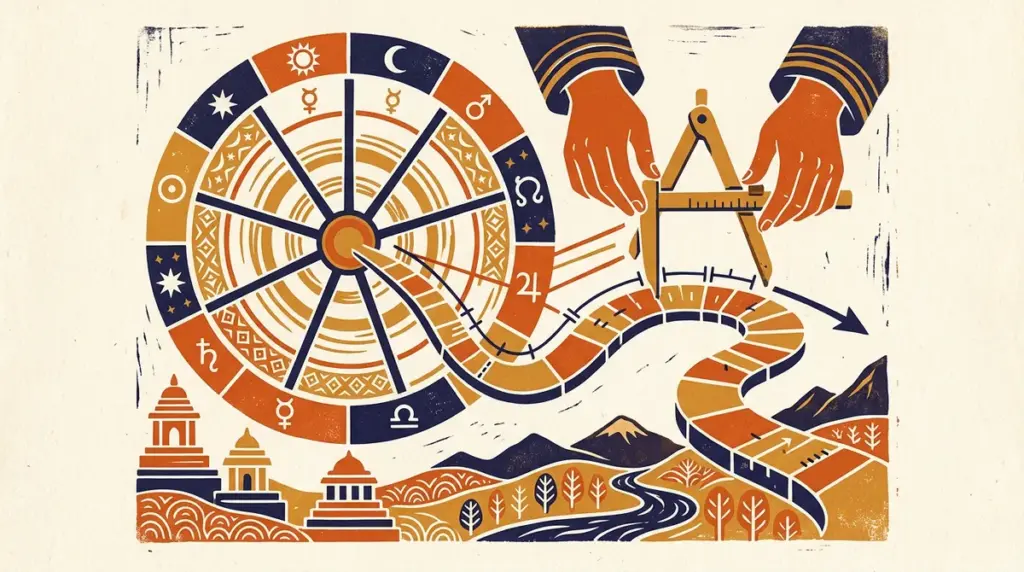
The antardasha period calculation method allows us to find the smaller sub-periods nested within a larger planetary cycle. In Vedic astrology, a Mahadasha is a long period of time governed by one planet. Within that long cycle, every planet takes a turn to influence your life for a shorter duration. This sub-period is called an Antardasha, or Bhukti. Understanding these segments helps you see the shifting themes in your personal journey.

Understanding the antardasha period calculation method
The system most commonly used is the Vimshottari Dasha. It operates on a cycle of 120 years. Each planet is assigned a specific number of years within this total cycle. The antardasha period calculation method relies on the proportional share of these years. You can see how your current cycle is evolving by using our Vimshottari Dasha tool.
The sequence always begins with the planet that rules the current Mahadasha. After that, the order follows the fixed sequence of planetary lordship. This ensures that every Mahadasha contains all nine planets in a predictable order. The duration of each sub-period is not equal. It depends on the length of the Mahadasha lord and the Antardasha lord.
How tradition views the antardasha period calculation method
Tradition treats the Mahadasha as the broad climate of a life phase. The Antardasha acts as the specific weather within that climate. Many texts suggest that the Mahadasha lord sets the foundation for the entire period. The Antardasha lord then adds its own unique flavor or challenge to that base.
Because the Moon’s position at birth determines the starting point, accuracy is very important. Even a small difference in your birth time can shift the dates. You may find it helpful to verify your birth data with a Kundli chart before performing any deep analysis. Tradition emphasizes that these periods are meant for reflection on growth rather than rigid prediction.
What observers notice about the antardasha period calculation method
Many people notice that their focus shifts as they move from one sub-period to another. You might feel a change in your daily habits or interests. This is often attributed to the change in the Antardasha lord. These transitions are gradual rather than sudden.
Astrologers look at the relationship between the two planets involved. If they are friendly, the experience is often described as smooth. If they are in a difficult position, the period might feel more demanding. You can learn more about how these periods unfold in Vimshottari Dasha Explained: Mahadasha, Antardasha and Timing.
Diverging traditions in calculation models
While the Vimshottari system is widely recognized, other systems exist in the tradition. Vedic astrology includes over 40 different Dasha systems. Some, like the Ashtottari or Yogini systems, use entirely different math. These systems are often used for specific purposes or in certain regional schools.
These variations remind us that there is no single way to view time in astrology. Each system offers a different lens for looking at the same life events. It is common for different practitioners to prefer one system over another based on their training. Always remember that these are tools for contemplation.
A calm approach to planetary timing
Astrology is for reflection and guidance, and it is not a substitute for professional advice.
It is best to approach these calculations with a steady mind. Treat the results as a roadmap for your own growth rather than a fixed set of outcomes. Your birth details are not stored on our servers. This ensures your privacy while you explore these ancient patterns.
A practical example of the calculation
Let us look at a simple example to see how the math works. Imagine a Mahadasha of the Sun, which lasts for 6 years in the 120-year cycle. To find the Sun-Sun Antardasha, we multiply the Mahadasha years by the Antardasha years. We then divide by the total 120 years.
- Sun Mahadasha: 6 years.
- Sun Antardasha share: 6 years.
- Calculation: (6 * 6) / 120 = 0.3 years.
- Result: The period lasts approximately 3 months and 18 days.
This proportional method ensures that every planet’s influence is weighed correctly. It keeps the entire 120-year cycle balanced and consistent for every individual.