When planning important daily tasks, many people turn to Vedic timing systems to find suitable moments. If you have ever wondered about choghadiya how it is calculated, the process is straightforward once you grasp the underlying division of time. Choghadiya is a traditional Vedic timekeeping system that divides daylight and nighttime into eight equal segments each. By checking local solar events and applying a fixed sequence of planetary influences, anyone can determine the prevailing quality of each period during the day.
Understanding the Eight Divisions: What Choghadiya Means
The term Choghadiya comes from two Sanskrit words: cho, meaning four, and ghadi, which refers to an ancient Indian unit of time measurement. In traditional astronomy, one ghadi equals exactly 24 minutes. Therefore, four ghadis combine to make 96 minutes, or one hour and 36 minutes. This 96-minute span represents the theoretical average duration of a single Choghadiya segment when daylight lasts exactly 12 hours.
In everyday practice, daylight is rarely exactly twelve hours long. The actual duration of sunlight shifts constantly depending on the time of the year and your geographical coordinates. Because of this natural variation, modern calculations do not simply fix each window at 96 minutes. Instead, the period from sunrise to sunset is measured accurately and then split into eight equal segments. The nighttime from sunset to the following sunrise undergoes the exact same eightfold division.
You can observe these shifts directly using our sunrise sunset tool, which highlights how solar intervals expand in the summer and contract during the winter months. Understanding this seasonal stretching is essential for anyone who wants to calculate Choghadiya accurately by hand.
The Seven Planetary Rulers Behind Each Period
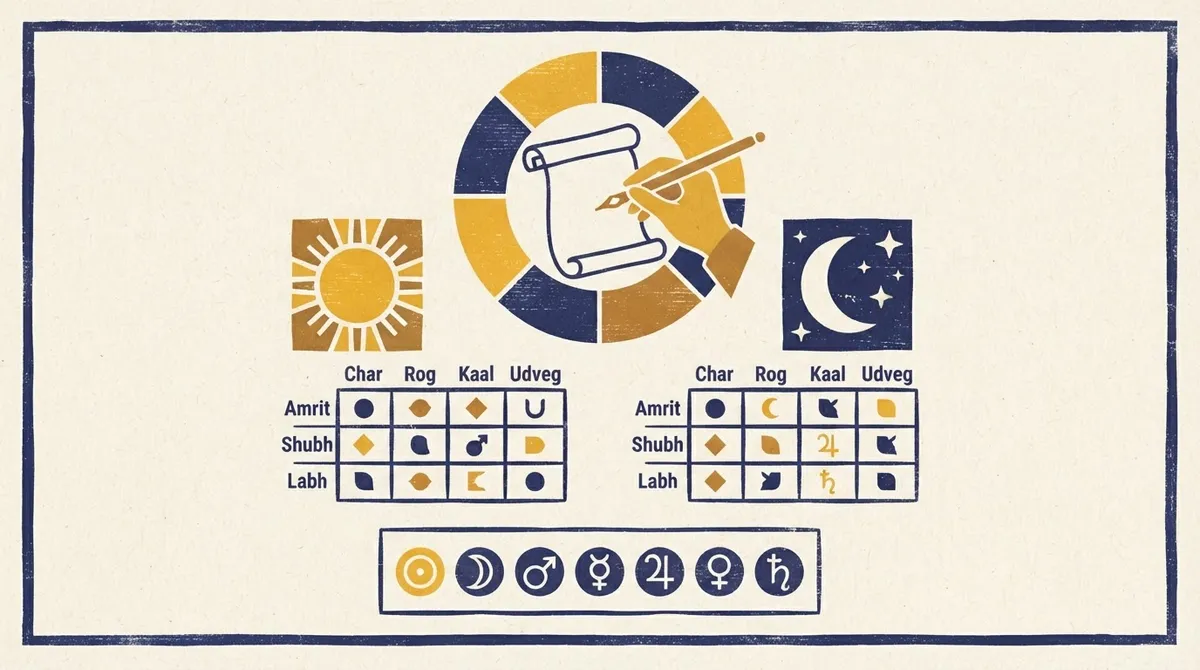
Although daytime and nighttime are divided into eight segments each, Vedic astrology recognizes only seven distinct types of Choghadiya. Each type is linked to a classical planetary deity and carries a specific traditional temperament:
- Amrit: Ruled by the Moon (Chandra). Traditional texts view this as one of the most auspicious periods, associated with peace, nourishment, and general success.
- Shubh: Ruled by Jupiter (Brihaspati). Regarded as auspicious for ceremonies, educational pursuits, and spiritual matters.
- Labh: Ruled by Mercury (Budha). Associated with commerce, financial gains, and learning new skills.
- Char: Ruled by Venus (Shukra). Considered neutral or movable, traditionally suitable for travel and quick activities.
- Udveg: Ruled by the Sun (Surya). Often viewed with caution for calm pursuits, though linked to government affairs.
- Kaal: Ruled by Saturn (Shani). Viewed as inauspicious for starting new ventures, but suitable for routine maintenance.
- Rog: Ruled by Mars (Mangal). Typically avoided for auspicious beginnings due to its association with conflict or debility.
Because there are eight distinct time slots in a day but only seven named types, one type always repeats in the eighth position. This cyclical rotation ensures that the planetary energy transitions smoothly into the night cycle without sudden gaps.
choghadiya how it is calculated: A Complete Worked Example
To see choghadiya how it is calculated in real life, let us walk through a clear, step-by-step mathematical example for a hypothetical Monday.
Step 1: Find Local Sunrise and Sunset
Suppose local sunrise occurs at 06:00 AM and local sunset occurs at 06:00 PM. In this scenario, the total duration of daytime is 12 hours, which equals 720 minutes. Calculating exact local solar times is always the necessary first step before doing any further math.
Step 2: Divide the Daylight Span into Eight Parts
Next, divide the total daylight duration by eight equal parts:
720 minutes ÷ 8 parts = 90 minutes per Choghadiya period.
Each period on this particular day will last exactly 1 hour and 30 minutes. If the day were longer—for instance, 13 hours (780 minutes)—each period would measure 97.5 minutes (1 hour, 37 minutes, and 30 seconds).
Step 3: Assign the Starting Ruler Based on Weekday
The first daylight segment is always ruled by the planet that governs that day of the week. Since our example is a Monday, the ruler of Monday is the Moon. The Moon corresponds to Amrit Choghadiya.
From the first slot, the remaining seven slots follow a fixed repeating order: Amrit, Kaal, Shubh, Rog, Udveg, Char, Labh, and back to Amrit. Here is how the complete daytime schedule appears:
- 06:00 AM – 07:30 AM: Amrit (Moon) – Auspicious
- 07:30 AM – 09:00 AM: Kaal (Saturn) – Inauspicious
- 09:00 AM – 10:30 AM: Shubh (Jupiter) – Auspicious
- 10:30 AM – 12:00 PM: Rog (Mars) – Inauspicious
- 12:00 PM – 01:30 PM: Udveg (Sun) – Inauspicious
- 01:30 PM – 03:00 PM: Char (Venus) – Neutral / Movable
- 03:00 PM – 04:30 PM: Labh (Mercury) – Auspicious
- 04:30 PM – 06:00 PM: Amrit (Moon) – Auspicious (Repeat)
You can verify these intervals instantly using our dedicated choghadiya calculator, which automates the arithmetic for any city in the world.
Day and Night Cycles: What Daily Observers Notice
People who observe Choghadiya daily often notice how daytime segments differ from nighttime segments. While day Choghadiya begins with the weekday lord, the night cycle (called Ratri Choghadiya) begins with the fifth planetary lord counted from the day lord according to the traditional sequence.
For instance, on a Monday, the night sequence does not start with Amrit. Instead, it begins with Char (ruled by Venus). Just as in the daytime, the night duration between sunset and the next morning’s sunrise is divided by eight. During winter, night periods are noticeably longer than daytime periods. During high summer, the daytime slots are substantially longer.
To learn how these time divisions fit alongside the other pillars of Indian timekeeping, read our overview of the five limbs of panchang.
Where Regional Traditions Differ on Choghadiya Calculations
While the mathematical rule of dividing daylight by eight is universal across all Vedic texts, minor differences exist among regional schools of astrology. Some traditions in Western India give immense weight to Choghadiya for spontaneous travel, immediate purchases, and urgent tasks. In other regions, astrologers prefer the classic Hora system (hourly divisions) or individual planetary hours for similar questions.
Furthermore, views differ regarding the neutral nature of Char. Some classical commentators view Char as slightly favourable for moving activities like travel or transport, while considering it unhelpful for stationary undertakings such as laying a foundation. Similarly, while Udveg is generally avoided for peaceful family matters, some traditions permit it for administrative and state-related paperwork because the Sun represents authority.
A Calm Way to Reflect on Daily Choghadiya Timings
It is helpful to treat Choghadiya as a practical framework for mindfulness rather than a source of worry. In ancient times, when clocks were uncommon, these natural divisions helped people organize work, travel, and rest in rhythm with the sun. If you miss an auspicious window like Shubh or Labh, you do not need to feel stressed. Daily life often requires flexibility.

Observing these windows encourages you to pause, check your intentions, and move through the day with greater focus. Combining Choghadiya with a general awareness of the sun’s rhythm can bring steady balance to your routine.
Astrology is for reflection and guidance, and it is not a substitute for professional advice.