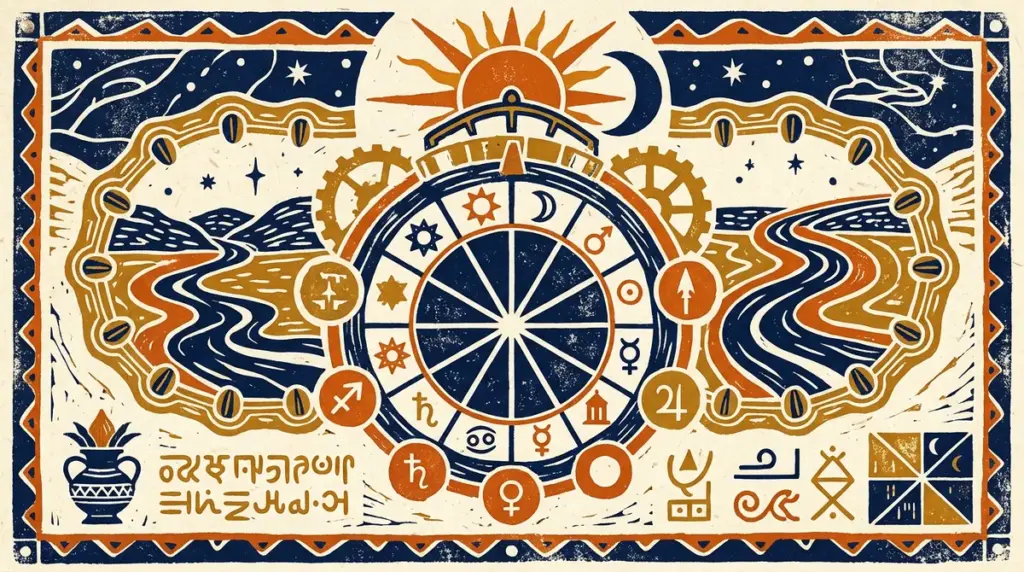
When you want to understand time divisions in Vedic astrology, looking at the complete cycle of planetary hours is a great place to start. A full hora chart full list explained gives you a clear view of how each segment of the day connects to a ruling planet. The term Hora comes from Ahoratra. This Sanskrit word encompasses the full duration of a day and night from one sunrise to the next.
You can use the panchang to find your local sunrise and sunset times before you map out your day. For more details on how broader calendar systems operate, you can read our guide on the five limbs of panchang.
What Hora Hours means for your daily schedule
Time is fluid in traditional study. Each day is split into active periods that carry unique qualities. People often look for ways to organize tasks around these natural rhythms.
Planetary hours offer a simple rhythm. They help you break the daylight and night hours into manageable parts. You can focus your mind on specific themes during each distinct block.
How tradition links Hora Hours with the 24-hour cycle
In Vedic astrology, the 24-hour cycle is divided into 24 planetary hours. Each hour is governed by one of the seven classical planets. This system relies on the relative speed of each celestial body.
To calculate the daytime Horas, the period between local sunrise and sunset is divided into 12 equal segments. The nighttime Horas are determined by dividing the period from sunset to the next sunrise into 12 equal parts.
Because the length of daylight and nighttime varies by location and season, a single Hora is rarely exactly 60 minutes long. Summer days create longer daytime segments. Winter days shorten those same daylight slots.
A clear guide to the hora chart full list explained
The first Hora of any day is always ruled by the planet associated with that specific weekday. For example, Sunday starts with the Sun. Monday starts with the Moon.
Following the first hour, the remaining Horas of the day proceed in a fixed, repeating sequence. This order is based on the relative orbital speeds of the planets. The sequence moves from the Sun through Venus, Mercury, Moon, Saturn, Jupiter, and finally Mars.
Let us look at a practical example for a Sunday. The very first hour after sunrise belongs to the Sun. The second hour shifts to Venus. The third hour moves to Mercury. This pattern repeats until all 24 hours of the full day and night cycle receive their planetary ruler.
Hora Hours and what readers notice in practice
Practitioners use the Hora system as a timing tool. They choose to align specific activities with the traditional significations of the ruling planet.
You might choose Mercury Hora for communication tasks. You might pick Jupiter Hora for study or spiritual pursuits. Many readers notice that having a structured routine helps them stay mindful of their daily goals.
Where schools differ on daily planetary timings
Different regions and teachers apply subtle variations to these calculations. Some schools measure sunrise precisely at the upper limb of the sun. Other traditions use the center of the solar disk.
These small technical choices shift the start time by a few minutes. You can test your local timings with our sunrise-sunset calculator. Tradition suggests you pick one reliable method and stick with it for your daily tracking.
A calm way to reflect on time using traditional hours
Astrology is for reflection and guidance, and it is not a substitute for professional advice. You do not need to manage every minute of your day with strict intensity. Instead, let these traditional markers prompt gentle pauses in your routine.
Use the changing hours to check your focus. Notice how your energy shifts as the planetary rulers turn through the day.