A kaal sarp dosha check helps you find out if all seven classical planets sit between the lunar nodes in your birth chart. In Vedic astrology (Jyotish), this specific pattern occurs when every major celestial body is enclosed on one side of the sky. Finding this combination allows you to understand how planetary placements shape your personal tendencies and life themes.
What Is a Kaal Sarp Dosha Check?
In Jyotish, a dosha (imbalance or challenging combination) points to specific planetary tensions. A Kaal Sarp pattern is technically a planetary combination known as a yoga (union or configuration). When people search for a Kaal Sarp assessment, they want to verify whether their natal chart contains this specific planetary alignment.
To check for this alignment, an astrologer looks at your kundli (birth chart). The chart maps the sky at your exact time and place of birth. Your birth details are not stored on our servers when you use our online tools, making it easy to examine your chart privately.
The Meaning of Kaal and Sarp
The name of this yoga comes from two Sanskrit words. Kaal means time or death. Sarp means serpent. In Vedic symbolism, the serpent represents cyclic time, deep karmic patterns, and restrictive boundaries. The two shadow planets, Rahu (north node of the Moon) and Ketu (south node of the Moon), are visualized as the head and tail of a cosmic serpent. When the other planets fall between them, the chart carries a theme of working within defined boundaries.
The Rahu-Ketu Axis Explained
Rahu and Ketu are not physical planets. They are mathematical intersection points where the path of the Moon crosses the ecliptic path of the Sun. In an astrological chart, Rahu and Ketu are always exactly 180 degrees apart. This means they occupy opposite houses. For example, if Rahu sits in the first house, Ketu must sit in the seventh house. This opposing line is called the nodal axis. It splits the twelve houses of the horoscope into two equal halves.
What the Chart Must Show to Form the Yoga
Not every chart with strong nodal placements has this yoga. Precise structural rules determine whether the combination is present. When you do a kaal sarp dosha check, you are testing your chart against these classic structural criteria.
The Rule of the Seven Classical Planets
In traditional Vedic astrology, seven primary physical bodies are evaluated: the Sun (Surya), the Moon (Chandra), Mars (Mangal), Mercury (Budha), Jupiter (Guru), Venus (Shukra), and Saturn (Shani). For the full yoga to form, all seven of these planets must reside within the continuous arc between Rahu and Ketu.
If even one planet sits outside this arc on the other side of the chart, the complete enclosure breaks. For example, if six planets sit between Rahu in the second house and Ketu in the eighth house, but Mars sits in the eleventh house, the complete pattern is not formed. The single planet outside the axis offers an energetic outlet for the chart.
Complete Hemming Versus Partial Placement
Astrological traditions interpret partial configurations differently. When all seven planets are strictly hemmed between Rahu and Ketu, many texts call it a Purna (full) Kaal Sarp Dosha. When one planet steps across the nodal axis, some traditions refer to it as an Anshik (partial) Kaal Sarp Dosha.
Other classical commentators argue that if any planet escapes the axis, the dosha does not exist at all. Because views differ among scholars, it is helpful to explore our detailed guide on kaal sarp dosha types and myths to see how various schools view these distinctions.
The 12 Types of Kaal Sarp Formations
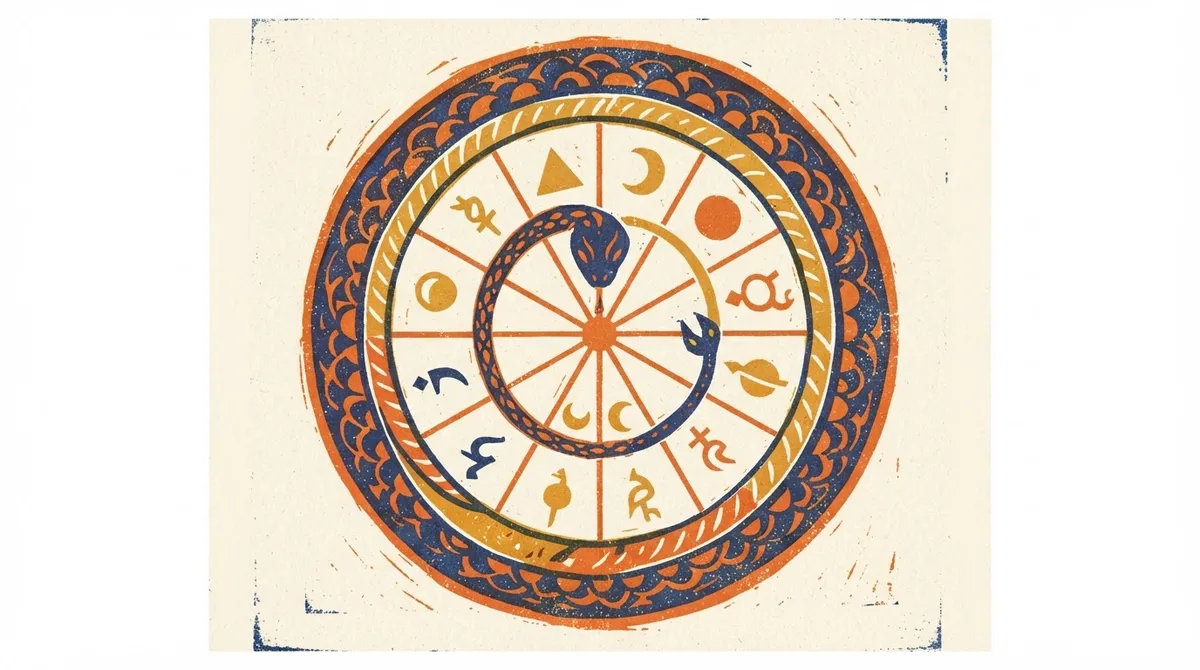
There are twelve main variations of this yoga. Each type takes its name from a mythological serpent deity and corresponds to the specific house axis occupied by Rahu and Ketu. The house placement determines which areas of life the boundary themes highlight.
Formations from House 1 to House 6
The first six types depend on Rahu sitting in houses one through six:
- Anant: Rahu occupies the 1st house (self, identity) and Ketu occupies the 7th house (partnerships). Focus centers on balancing personal goals with relationship needs.
- Kulik: Rahu sits in the 2nd house (wealth, speech) and Ketu sits in the 8th house (transformations). Themes involve managing shared resources and honest communication.
- Vasuki: Rahu rests in the 3rd house (effort, siblings) and Ketu rests in the 9th house (philosophy, mentors). Attention turns toward personal initiative and higher learning.
- Shankhpal: Rahu resides in the 4th house (home, inner peace) and Ketu resides in the 10th house (profession). This emphasizes balancing domestic life and public status.
- Padma: Rahu is in the 5th house (creativity, intellect) and Ketu is in the 11th house (social circles, gains). Themes focus on intellectual output and long-term friendships.
- Mahapadma: Rahu sits in the 6th house (daily routines, obstacles) and Ketu sits in the 12th house (solitude, release). The focus is on handling everyday responsibilities with patience.
Formations from House 7 to House 12
The remaining six variations occur when Rahu is placed in the upper houses, reversing the nodal direction:
- Takshak: Rahu in the 7th house and Ketu in the 1st house. Life lessons revolve around interpersonal dynamics and self-reliance.
- Karkotak: Rahu in the 8th house and Ketu in the 2nd house. This combination emphasizes deep self-inquiry and mindful financial habits.
- Shankhchood: Rahu in the 9th house and Ketu in the 3rd house. The chart highlights spiritual exploration and courage in daily actions.
- Ghatak: Rahu in the 10th house and Ketu in the 4th house. Focus turns toward career growth and building an inner sense of stability.
- Vishdhar: Rahu in the 11th house and Ketu in the 5th house. Lessons involve setting practical goals and nurturing community ties.
- Sheshnaag: Rahu in the 12th house and Ketu in the 6th house. The native often explores quiet contemplation alongside structured work routines.
How to Run a Kaal Sarp Dosha Check Step by Step
You can verify this combination manually or by using automated tools. Here is how you can systematically check your chart:
- Generate your chart: Use an online tool or software to calculate your Vedic birth chart based on your exact birth time, date, and location. You can test your chart immediately with our dedicated kaal sarp dosha calculator.
- Locate Rahu and Ketu: Identify which houses contain Rahu and Ketu. Note their signs and exact degrees.
- Map the remaining planets: Check the house positions of the Sun, Moon, Mars, Mercury, Jupiter, Venus, and Saturn.
- Verify the arc: Trace the path from Rahu to Ketu. See if all seven planets sit on one side of this axis. If any planet is on the other side, the full enclosure is broken.
- Inspect planetary degrees: If a planet shares a house with Rahu or Ketu, check its degree. If it sits beyond the degree of the node, it may break the hemmed formation.
Just as an inquiry into what is manglik dosha requires checking Mars placements across multiple houses, evaluating Kaal Sarp requires checking the whole chart layout.
Factors That Modify the Influence
In Vedic astrology, no single planetary combination acts alone. A chart must be read as an integrated whole. Several balancing factors can soften the restrictive themes of a nodal axis:
- Benefic aspects: Favorable aspects from natural benefics like Jupiter or Venus toward the ascendant or key house lords offer constructive balance.
- Strong ascendant lord: When the ruling planet of your first house is well-placed by sign and house, it provides strong vitality and resilience.
- Dasha periods: Planetary timing matters. Using the vimshottari dasha system reveals when specific planets become active. The nodal axis is most prominent during Rahu or Ketu periods.
- Exalted planets: Strong planets placed in signs of exaltation or their own signs provide solid foundations that balance challenging chart areas.
- Mindful habits: Many traditions suggest regular meditation, clear daily routines, and constructive actions to channel intense nodal energies into positive growth.
Understanding the Limits of Chart Analysis
Finding a Kaal Sarp alignment does not mean your life is fixed on a single path. Many historical leaders, artists, and scholars have charts containing this exact yoga. In practice, the pattern often brings focus, deep drive, and an ability to master complex life lessons over time.
Astrological charts provide a symbolic framework for self-reflection. When you review your planetary placements, treat the observations as constructive guidance rather than absolute conclusions.
Astrology is a tool for personal reflection and guidance, not a substitute for professional legal, medical, or financial advice. Use chart insights to build self-awareness and make thoughtful, grounded life decisions.