When you study Vedic astrology, time flows in fixed cycles called dashas. The moon mahadasha duration spans exactly ten years in your life journey. This major planetary period invites you to focus on the mind and inner feelings. You can map these changes easily when you use the vimshottari dasha tool.
What the moon mahadasha duration means in your chart
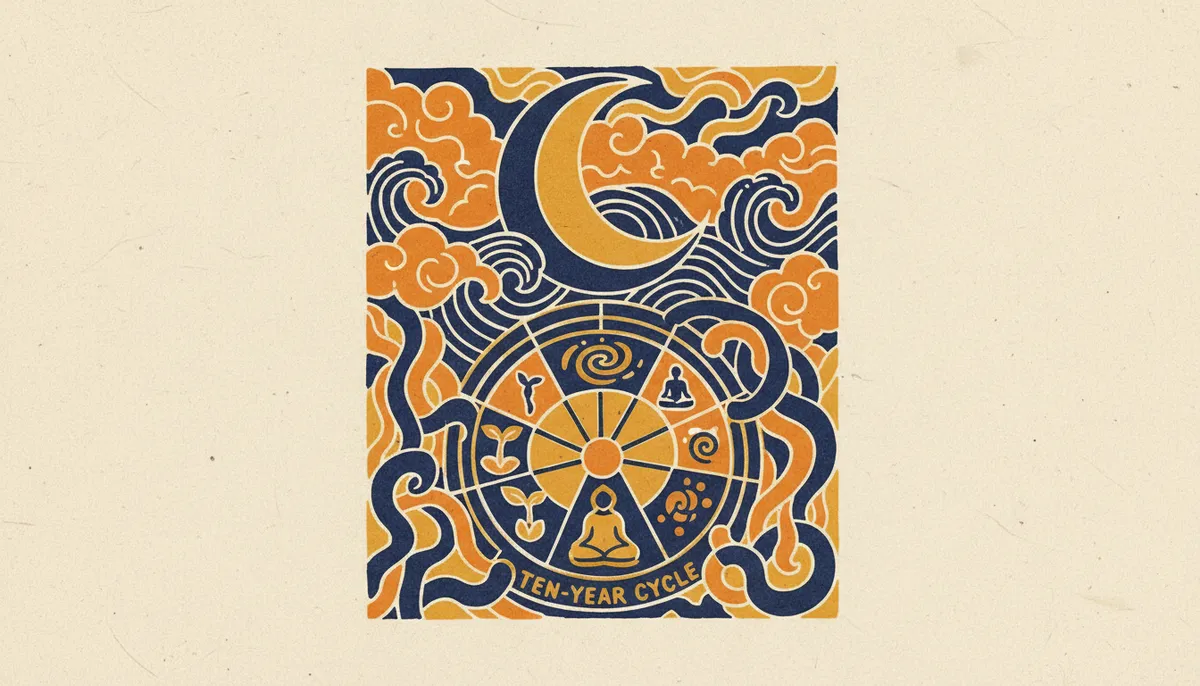
Every major period in the Vimshottari system carries a set length. The Moon holds a ten-year slot in this sequence. This period follows the six-year Sun cycle and leads right into the seven-year Mars cycle. The total span of ten years is fixed by ancient rules.
You might wonder how this length affects your daily life. The period does not bring identical experiences to everyone. Instead, it offers a background tone for your emotional world. Your natal chart shapes how these ten years unfold for you. You can check your broader planetary setup with our kundli calculator.
Astrology asks us to view time as a circle rather than a straight line. Ten years is long enough to complete major personal shifts. You might start this period with one set of goals and finish with entirely new priorities. The Moon governs the subconscious mind. This means your inner focus shifts toward home, family, and personal comfort.
How Vedic texts connect the Moon and time
Classical texts like Brihat Parashara Hora Shastra lay out these timelines. The sages set the Moon period at ten years because of fixed mathematical ratios in the sky. They viewed the Moon as the fast runner of the zodiac. Its cycle reflects the rapid changes of the human mind.
In Vedic tradition, the Moon is called Chandra. Chandra represents emotion, motherly care, and public life. When Chandra takes charge of your dasha sequence, these themes step forward. The duration is split into smaller parts called Antardashas. Each sub-period brings a different planetary flavor to your ten-year journey. You can read more about how sub-periods work in this guide on Vimshottari Dasha Explained.
The exact timing of when you enter this period depends on your birth moment. The placement of the Moon in your birth nakshatra, or lunar mansion, sets your starting balance. If you are born with the Moon in Rohini, Hasta, or Shravana, you start life with a specific portion of this ten-year span already underway. Other nakshatras place this cycle at different ages in your life.
A worked example of ten years
Let us look at a simple example to see how the ten years divide. Imagine a person who starts their Moon period at age twenty. The entire span lasts from age twenty to age thirty. This ten-year block is divided into nine smaller parts.
The first sub-period belongs to the Moon itself. It lasts for a fraction of the ten years based on fixed ratios. Next comes the Mars sub-period, followed by Rahu, Jupiter, Saturn, Mercury, Ketu, Venus, and the Sun. Each sub-lord colors the main theme of the ten-year span.
For instance, the Moon-Mars sub-period might bring quick action and high energy. Later, the Moon-Jupiter sub-period might bring study, reflection, and family focus. These shifts happen smoothly over the ten years. You do not wake up with a new life overnight. Instead, the emotional climate drifts from one theme to the next.
Where traditional schools differ on timing
Astrologers do not always agree on every detail of dasha interpretation. Some traditions place great weight on whether the Moon is waxing or waning at birth. A bright, waxing Moon is often viewed as strong and steady. A dark, waning Moon is viewed as introspective and quiet.
Other texts look closely at divisional charts to judge the strength of the Moon. They check the Navamsa chart to see how the Moon performs in deeper layers of the chart. You can explore these deeper layers using our navamsa-chart tool.
Despite these different views, the basic ten-year duration remains the same across standard schools. The debate is about quality and expression, not about the length of the time. Tradition reminds us to look at the whole chart rather than one planet alone.
What readers notice during this period
People often report a change in their sleep and daily habits during these ten years. The mind becomes more sensitive to the environment. You might feel a stronger pull toward your home town or your mother. Many people use this time to fix up their living spaces or change careers to something more comforting.
Others find that their creative output peaks during this decade. The Moon rules imagination and art. Writers, painters, and musicians often feel a deep surge of inspiration when Chandra rules their chart.
It is important to remember that these changes are gentle. Astrology is for reflection and guidance, and it is not a substitute for professional advice. Use these insights to understand your own moods and natural cycles.
A calm way to reflect on time
Time management in astrology is about patience. A ten-year period gives you plenty of room to learn and grow. Do not rush to judge your current dasha as good or bad. Every phase teaches you something useful about yourself.
Take time each month to check your progress. Notice what brings you peace and what drains your energy. The Moon teaches us about the ebb and flow of life. Just as the ocean tides rise and fall, your mental energy will shift over these ten years.
Keep a simple journal of your thoughts. Look back after a few years to see how your perspective has changed. This habit turns astrological study into a tool for self-awareness and steady personal growth.